
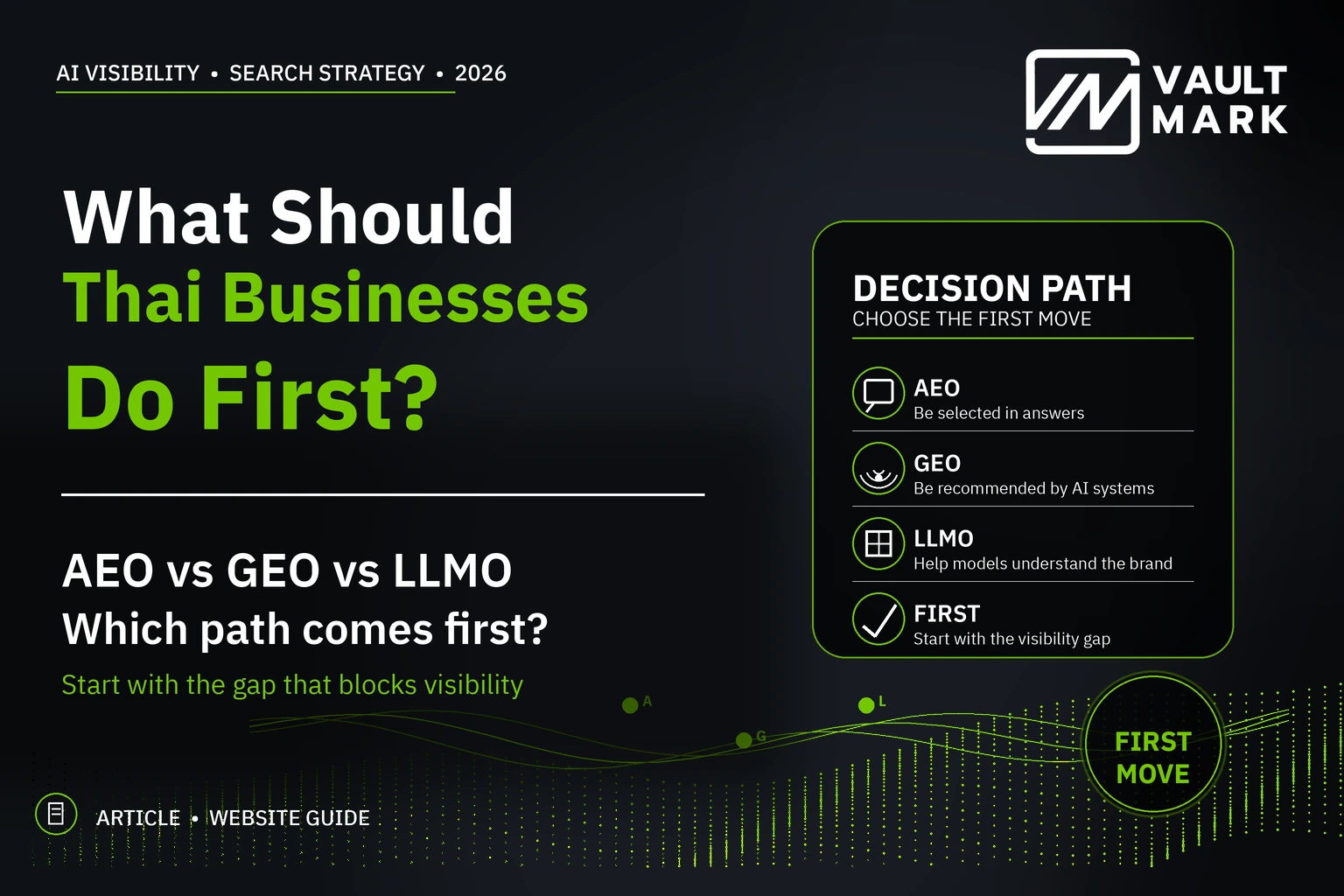
A marketing team starts discussing AEO, GEO and LLMO at the same time. One agency proposes an “AI Search package,” yet nobody can confirm whether the site is fully indexable, which buyer questions matter, or what evidence makes the brand worth citing. Buying the stack before diagnosing the bottleneck can increase activity without improving discovery, trust or qualified demand.
What do AEO, GEO and LLMO mean in practical terms?
There is no universal taxonomy used consistently by platforms, researchers and agencies. This article therefore applies explicit working definitions for decision-making rather than presenting the labels as settled industry standards.
| Discipline | Primary question | What it addresses | Readiness evidence |
|---|---|---|---|
| SEO | Can search systems access, understand and index the right page? | Crawlability, indexability, information architecture, search intent, internal linking and page quality | Priority pages are indexable, query ownership is clear and no canonical or robots conflict exists |
| AEO | Can people and answer systems extract a clear, bounded answer? | Answer-first copy, headings, definitions, FAQs, comparisons, tables and independently useful passages | The answer states conditions, exceptions and a decision without ambiguity |
| GEO | Does the brand publish information and evidence worth citing in a generated answer? | Original evidence, entity clarity, citation assets, expert review, external corroboration and traceable sources | Claims have sources, methods, limitations, review dates and genuine information gain |
| LLMO | Can the organisation manage brand visibility and accuracy across LLM-mediated discovery? | Prompt baselines, crawler access, entity consistency, monitoring, governance, ownership and feedback loops | Owners, prompt sets, correction workflows and separate mention/citation/recommendation metrics exist |
Google states that eligibility for AI Overviews and AI Mode still depends on normal Search requirements: a page must be indexed and eligible to show a snippet, with no special AI markup required. OpenAI states that public websites may appear in ChatGPT Search and advises publishers not to block OAI-SearchBot when they want content to be discoverable, displayed and cited. The operational conclusion is straightforward: AI search does not remove SEO; it adds answer, evidence and governance layers.
The Vault Mark Four-Gate Decision Matrix
Vault Mark methodologyThis is a professional diagnostic method, not a platform standard or guaranteed ranking formula. It replaces label-led procurement with a constraint-led decision.
| Gate | Diagnostic question | Failure consequence | First intervention | Do not buy yet |
|---|---|---|---|---|
| 1. Accessibility | Can the target page be crawled, rendered, indexed and discovered through relevant internal links? | The source may never enter the eligible evidence pool | Technical SEO, query ownership and internal architecture | A large GEO campaign or monitoring suite |
| 2. Answerability | Does each page answer one buyer question clearly, with conditions and extractable passages? | The page is found but is difficult to use as an answer | AEO content engineering | More undifferentiated article volume |
| 3. Citability | Are material claims supported by methods, primary sources and distinctive evidence? | The content is interchangeable and gives no reason to cite this source | GEO evidence assets, corroboration and entity strengthening | Any “guaranteed AI citation” claim |
| 4. Operability | Are prompt baselines, owners, review cadences and separate visibility metrics in place? | Teams collect screenshots without knowing whether results repeat, remain accurate or create value | LLMO governance and measurement | Multiple monitoring tools without decision rules |
The gates are not rigid departments. They are an investment sequence: avoid scaling the next layer while an earlier layer remains the dominant constraint.
Should your business start with AEO, GEO or LLMO?
Start with the SEO foundation when access and ownership remain uncertain
Typical signals include missing sitemap entries, conflicting canonicals, accidental noindex directives, important copy unavailable in rendered HTML, broken Thai–English relationships, orphan pages or several pages competing for the same query. Resolve these issues before building citation assets. See how SEO services should connect technical access, content and measurement, and use the Vault Mark article hub to understand the surrounding content structure.
Start with AEO when content is discoverable but fails to make a decision clear
A page may contain plenty of information while burying the answer, avoiding conditions, using headings that do not match buyer questions or presenting comparisons without criteria. The first move is to engineer direct answers, definitions, tables, scenarios and limitations—not to manufacture a large FAQ section. Google now limits FAQ rich-result visibility and has deprecated HowTo rich results in general Search, so markup should not drive the content strategy.
Start with GEO when useful answers exist but there is little worth citing
GEO becomes relevant when a business has genuine expertise but publishes only generic commentary. Build a reusable evidence object: a scorecard, methodology note, anonymised audit, decision matrix or dataset with limitations. This extends Vault Mark’s guide to Generative Engine Optimization and citation-ready assets, while this page answers a different question: when should GEO be the first investment?
Start an LLMO operating layer when the bottleneck is organisational
LLMO is useful when several teams, languages, domains or AI platforms represent the brand inconsistently. The work then concerns canonical facts, ownership, monitoring, governance and correction—not merely rewriting one article. It should separate a brand mention from a direct source citation and from a provider recommendation.
How does the first move change by business model?
| Situation | Observed symptom | Best first move | Why | Next evidence |
|---|---|---|---|---|
| Sales-led B2B | Some rankings remain, but prospects ask basic questions and sales reports poor fit | AEO plus buyer-question mapping | Answers must clarify context, readiness and decision criteria before traffic volume expands | More specific enquiries and a measurable path to qualified leads |
| Local business | Name, address, services and coverage differ across the site, profiles and directories | SEO and entity consistency | GEO would amplify unstable facts rather than solve them | Consistent entity facts and indexable location/service pages |
| E-commerce | Products are indexed, but differentiation, comparison and review evidence are weak | Product AEO, then GEO | First make product answers complete; then add original comparison or usage evidence | Extractable product answers, accurate merchant data and evidence-led comparisons |
| Specialist knowledge brand | Strong private expertise, generic public articles | A GEO evidence asset | The bottleneck is publishable, reviewable evidence—not content volume | A method, reviewer, limitations and reusable citation object |
| Multi-brand or multi-market organisation | AI answers mix product names, executives or policies from different versions | LLMO governance and source-of-truth architecture | The problem is cross-system accuracy, ownership and correction | Higher answer accuracy, more stable cited URLs and closed error workflows |
A 90-day sequence without overbuilding the stack
- Days 1–15: Establish the baseline and query ownership.
Select commercially meaningful buyer questions. Audit sitemap coverage, indexability, language pairs, current answers and cited competitors. Record mention, citation and recommendation separately. - Days 16–35: Repair the first failed gate.
Resolve technical access or rewrite the query-owning page with a direct answer, decision object, source notes and the correct commercial route. - Days 36–60: Create one information-gain asset.
Choose a missing object such as a proposal checklist, benchmark method, decision matrix or field note. Publish the method and limitations. - Days 61–75: Strengthen entities and corroboration.
Align brand, expert, service and topic facts. Improve internal links and seek legitimate expert review or practitioner contribution without manufactured endorsements. - Days 76–90: Repeat tests and make the next decision.
Use the same prompt set with semantic variations and repeated runs. Record accuracy, cited URL, competitors, referrals and qualified enquiries. Then steward, expand or replan.
How should AEO, GEO and LLMO be measured?
| Measurement layer | Signals | Decision answered | Limitation |
|---|---|---|---|
| Technical | Index eligibility, crawler access, canonical/hreflang and internal discovery | Can the source enter the discovery system? | Eligibility is not selection |
| Answer | Question coverage, factual accuracy and passage completeness | Does the page provide a usable answer? | Keyword counts do not establish usefulness |
| AI visibility | Brand mention, direct citation, recommendation, cited URL and context | How and where does the brand appear? | Outputs vary by prompt, platform, model and time |
| Business | AI referral, assisted conversion, qualified enquiry and CGB conversion | Does visibility improve a business decision? | Attribution can be incomplete; label observed and inferred effects |
| Trust | Answer accuracy, correction time and citation stability | Can the representation remain reliable? | An inaccurate mention is not success |
Measurement architecture should define the baseline and decision rules before tool procurement. Search and answer improvements should connect to AI Search Optimization without separating AI visibility from website quality and source integrity.
Common mistakes that put AI-search investment in the wrong order
- Buying the newest label: the proposal replaces “SEO” with “GEO,” but deliverables and evidence remain unchanged.
- Skipping technical eligibility: teams build citation assets while target pages are noindexed, orphaned or canonically conflicted.
- Turning AEO into an FAQ factory: question volume grows without helping the buyer decide.
- Turning GEO into unsupported authority language: claims sound confident but lack methods, sources and limitations.
- Measuring LLMO with one screenshot: no timestamp, prompt variation, platform record or cited URL exists.
- Scaling before proof: multiple topics, languages and platforms launch before the first wave indexes and produces interpretable signals.
Frequently asked questions
Can AEO replace SEO?
No. AEO improves answer clarity and extractability, but it does not independently solve crawling, indexing, canonicalisation, internal architecture or duplicate query ownership.
Does GEO require special Schema?
Google states that no special schema is required for AI Overviews or AI Mode. Structured data should represent visible content accurately, and valid markup does not guarantee a citation or rich result.
Is LLMO simply rewriting text for a model?
Not in this operating definition. LLMO covers source access, entity consistency, prompt baselines, governance, monitoring and correction across platforms. It is not a hunt for secret wording that forces model outputs.
Does a small business need all four gates?
Not at once. A small business should select a narrow, high-value buyer question, repair the first failed gate and create one defensible evidence asset before expanding.
How long does an AI citation take?
No responsible timeline can be guaranteed. Crawl and index cycles, the query, platform, model, source competition and evidence quality all matter. Track controllable milestones—eligibility, answer quality, evidence completion and repeated baseline tests—instead.
Limitations, methodology and source notes
AEO, GEO and LLMO terminology is evolving, and vendors use the labels differently. The Four-Gate framework is professional methodology for prioritisation, not an experimental claim or guaranteed outcome. Early GEO research was conducted under specific evaluation conditions; its reported improvements should not be treated as proof of durable organic discovery or business impact across deployed platforms.
- Google Search Central: AI features and your website — index eligibility, SEO fundamentals and the absence of special AI markup; reviewed 28 July 2026
- Google Search Central: Introduction to structured data — markup must match visible content and cannot guarantee display
- Google Search Central: Changes to HowTo and FAQ rich results — reduced FAQ visibility and deprecation of HowTo rich results
- OpenAI: Publishers and developers FAQ — OAI-SearchBot access and ChatGPT Search discovery
- Aggarwal et al.: GEO—Generative Engine Optimization — foundational research context, with results bounded by its experimental setting
The next decision: repair the bottleneck, not the terminology
The practical choice is not “AEO or GEO.” It is identifying whether Accessibility, Answerability, Citability or Operability is currently losing the opportunity—and selecting an intervention small enough to measure but material enough to change the next decision.
Published: 28 July 2026 · Review when crawler policies, AI-search reporting or structured-data support materially changes