
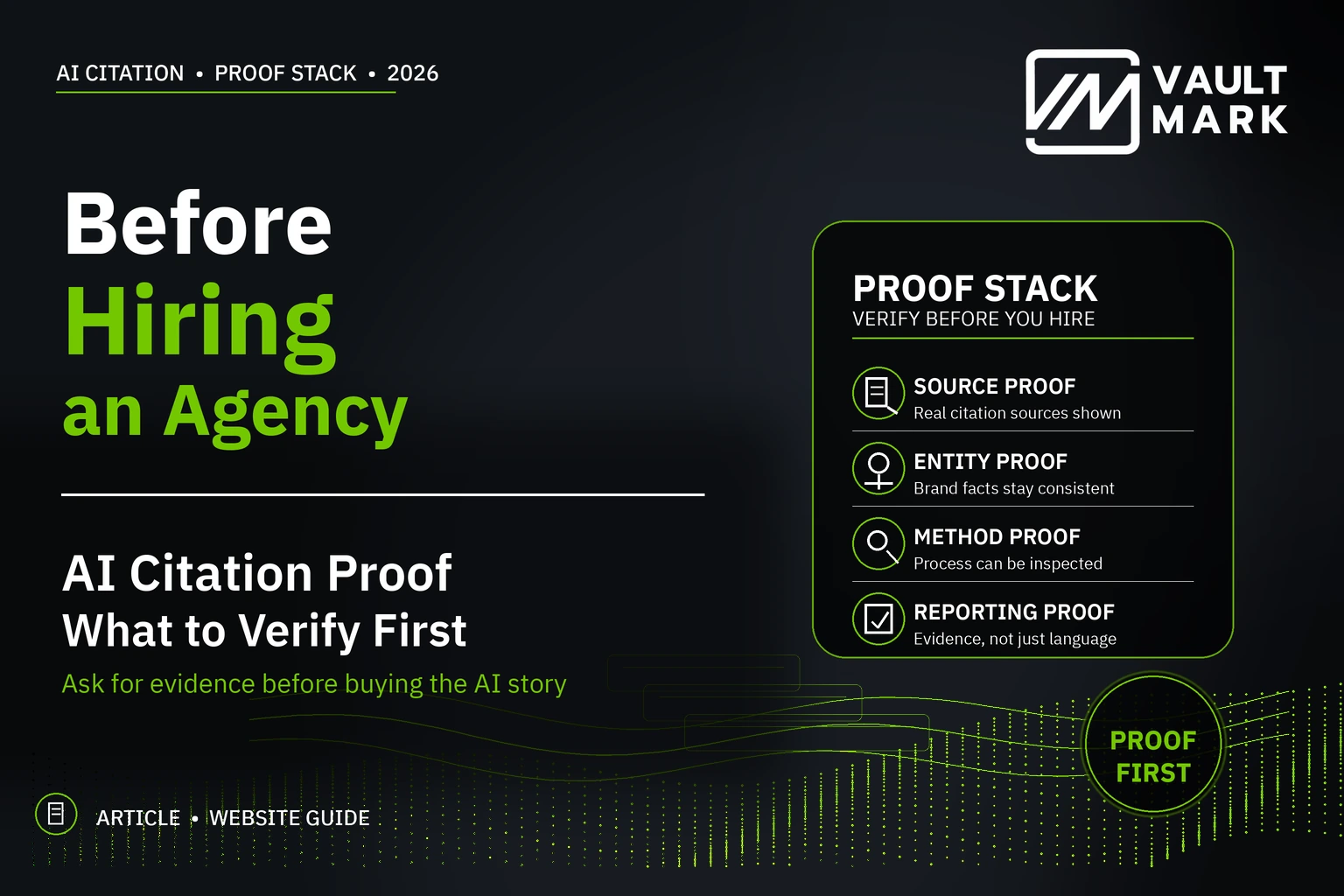
When executives see a screenshot showing their brand in an AI answer, the useful next question is not “Does this look impressive?” It is “What does this actually prove?” A single result may depend on one prompt, one account, one language, one location or one moment in time. If an agency cannot disclose those conditions, the buyer is purchasing a claim rather than a verifiable system.
Why is one screenshot only an observation?
A screenshot proves that one system produced one answer at one time. It does not show the full prompt, language, location or account context, whether the result repeated, which URL was cited, whether that page supported the answer, or whether the exposure produced a qualified enquiry.
Google states that AI Overviews and AI Mode can show different responses and links, and that meeting technical requirements does not guarantee crawling, indexing or serving. OpenAI likewise says there is no way to guarantee top placement in ChatGPT Search, although allowing OAI-SearchBot is important for discoverability. Evidence therefore needs traceability and repeated testing, not a polished image alone.
What belongs in an AI Citation Proof Stack?
The following AI Citation Proof Stack is a Vault Mark professional methodology for buyer evaluation. It is not a platform-endorsed standard or certification.
| Evidence layer | What to inspect | Verification question | Risk when absent |
|---|---|---|---|
| 1. Measurement definition | Separate mention, citation, recommendation and referral | Does a reported “citation” include a real source link? | Different signals are merged into an inflated metric |
| 2. Prompt log | Full prompt, platform, language, date/time and context | Can another person repeat the test? | Only favourable prompts are selected |
| 3. Citation trace | Answer, source card, final URL and supporting passage | Does the page actually support the AI answer? | An irrelevant URL or domain mention is presented as proof |
| 4. Repeatability | Multiple runs, days and semantic variations | How often did it recur, and is variance disclosed? | A one-off event is sold as a durable capability |
| 5. Source readiness | Crawl/index eligibility, canonical, authorship, dates and sources | Is the source accessible and clearly governed? | Temporary visibility without a controllable source base |
| 6. Business relevance | AI referral, assisted conversion, qualified enquiry and CGB conversion | How did the evidence influence a business decision? | The team wins screenshots but cannot identify customer value |
1) Define the metric before counting it
A brand mention names the brand without a source link. A direct citation links or points to a brand-owned URL. A recommendation presents the brand as suitable for the user’s conditions. These should not be combined: a citation is not automatically a recommendation, and a mention does not demonstrate referral traffic.
2) Make the prompt log reproducible
Store the full prompt—not just its topic—along with platform, language, date, time, country or location context where relevant, and whether a fresh session was used. This does not make the output stable; it makes differences auditable and reduces cherry-picking.
3) Trace every citation to a supporting passage
Evidence should include the final URL after redirects and identify the visible passage that supports the answer. If the AI answer exceeds what the page says, that is an answer-accuracy risk, not an outcome to celebrate.
4) Test repeatability without pretending it is certainty
Run the primary buyer question and semantic variants across multiple days, and disclose both positive and negative results. Avoid inventing a universal success-rate threshold. The purpose is to understand patterns and volatility—not to force a platform to produce identical answers.
5) Verify source and technical readiness
Google says a page must be indexed and eligible to appear with a snippet to be considered as a supporting link in its AI features, and structured data should match visible content. OpenAI advises publishers not to block OAI-SearchBot when they want content to be discoverable and cited in ChatGPT Search. These are readiness conditions, not citation guarantees.
6) Connect visibility to business relevance
Track AI referrals, landing-page engagement, form starts, qualified enquiries and assisted conversions separately from mentions and citations. The commercial question is whether the right buyers are making better decisions—not merely whether the brand appeared once.
AI Citation Evidence Scorecard: 12 points
Score 0 when evidence is absent, 1 when it exists but is incomplete, and 2 when another person can verify it.
| Criterion | 0 | 1 | 2 |
|---|---|---|---|
| Metric definition | Everything is called a citation | Some separation | Mention/citation/recommendation/referral separated |
| Prompt log | None | Prompt without full context | Prompt, platform, language, date/time and context |
| Cited URL trace | Screenshot without URL | URL shown, passage unchecked | Final URL and supporting passage verified |
| Repeatability | One run | Limited retesting | Multiple runs/days/variants with negative results |
| Source readiness | Unchecked | Partial checks | Crawl, index, canonical, authorship, sources and dates checked |
| Business relevance | Visibility only | Some referral evidence | Referral, qualified enquiry and assisted conversion separated |
What should you ask an agency?
- How do you distinguish a mention, citation and recommendation?
- Can we inspect the complete prompt log with platform, language and timestamps?
- Will you show both successful and unsuccessful test runs?
- Can each citation be traced to a final URL and supporting passage?
- How many runs, days and semantic variations are included?
- How do you check robots.txt, indexability, canonical and snippet eligibility?
- How do you separate AI referral traffic from other organic traffic?
- How do you audit answer accuracy and correct the source ecosystem?
- Who owns prompt logs, dashboards, content and analytics access after the engagement?
- Which examples are verified client outcomes, demos or professional judgement?
This guide owns the evidence-verification decision rather than the entire agency-selection process. Use it alongside checks for scope, ownership, measurement and team fit before signing an engagement.
Practical scenario: identical screenshots, unequal proof
Agency A shows one screenshot in which an AI answer names a brand, but does not disclose the prompt, date or cited URL. Agency B provides a 20-prompt test set in Thai and English, records several days, includes both hits and misses, and maps each citation to a source page with limitations.
Both agencies have attractive screenshots. Only B provides enough traceability to evaluate method, variance and source readiness. That does not mean B can guarantee future citations; it means the buyer can assess the work more rationally.
Before deciding, review Vault Mark’s showcase, portfolio, and guide on conditions that can improve ChatGPT citation readiness. Treat proof of work, proof of process and proof of outcome as separate objects.
Which mistakes weaken an evidence review?
- Counting every mention as a citation: this inflates the metric.
- Showing only winning prompts: this hides volatility.
- Using screenshots without source URLs: answer accuracy cannot be checked.
- Presenting schema as a shortcut: Google states there is no special schema that guarantees inclusion in AI features.
- Ignoring canonical and language relationships: incorrect TH/EN configuration can obscure the intended URL owner.
- Selling visibility without lead measurement: appearance alone does not show buyer value.
What limitations must be disclosed?
AI outputs can vary by platform, model, time, location, personalisation and prompt. Allowing crawlers, improving SEO/AEO/GEO, adding valid structured data and publishing reliable content improve readiness but cannot guarantee a mention, citation, recommendation or ranking. Use a fixed prompt baseline and record every test date for honest comparison.
This article is a service-provider evaluation framework, not an endorsement by Google or OpenAI and not legal or organisation-specific procurement advice.
Next decision: require reproducible evidence before increasing spend
When it is still unclear whether the constraint is the source, website, content, measurement or provider capability, start with the Customer Growth Blueprint. It is designed to clarify what should be diagnosed and prioritised before a larger implementation stack is purchased.
For further context, review Vault Mark’s digital marketing agency approach in Bangkok and AI Search Optimization pathway.