
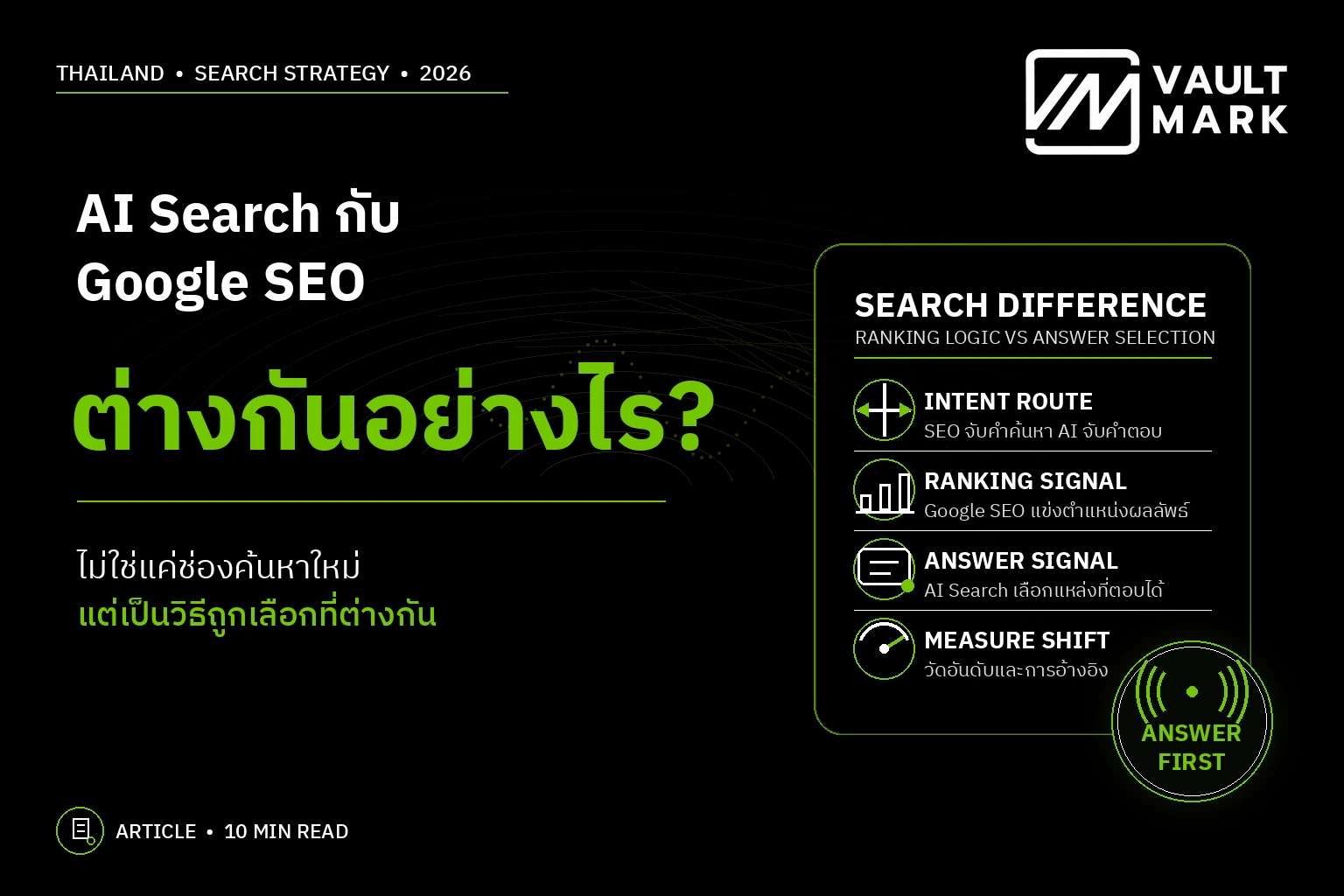
AI Search gives users a synthesised answer from systems such as ChatGPT, Perplexity, Microsoft Copilot, Google AI Overviews, or Google AI Mode, while traditional Google SEO competes for visibility in a ranked list of links. The two environments overlap, but they do not create visibility in exactly the same way. A business that tracks rankings alone may therefore miss where it is being excluded from AI-generated answers.
The central difference is the outcome being pursued. SEO aims to earn visibility in search results so users can choose whether to click. AI Search aims to make a brand, page, or source eligible to be selected, mentioned, or cited within a generated answer. Traditional organic traffic remains valuable, but part of the customer’s evaluation may now happen before a website visit. A brand can therefore retain strong Google rankings while losing visibility in AI-assisted consideration.
A Direct Comparison Across the Main Dimensions
| Dimension | Traditional Google SEO | AI Search |
|---|---|---|
| Primary competition | Visibility and position within ranked search results | Selection, mention, or citation within a generated answer |
| Typical user journey | Scan results → choose a link → read the page | Ask a detailed question → read a synthesised answer → open selected sources when more detail or verification is needed |
| Core metrics | Rankings, impressions, clicks, organic sessions, and conversions | Mentions, citations, cited pages, AI referral traffic, and AI Share of Voice within a defined prompt set |
| Factors that support visibility | Technical eligibility, relevance, content quality, links, authority, and page experience | Retrieval eligibility, relevance to the exact question, clear answer structure, source quality, corroboration, and evidence that can support the generated response |
| Effect of a large domain | Established authority and link equity can create a substantial advantage | Domain strength can still help discovery and trust, but a highly relevant page from a smaller site may compete when it resolves the specific question more clearly |
| Common blind spot | Rankings or organic traffic decline | Enquiries or brand consideration weaken even though conventional rankings remain stable |
What Still Works from Traditional SEO
The SEO work already completed is not obsolete. Technical accessibility, crawlable internal links, accurate indexing signals, useful content, clear site structure, brand credibility, and strong page experience continue to support both conventional search and AI-powered search experiences. Google explicitly states that its established SEO best practices remain relevant for AI Overviews and AI Mode, which draw from the core Search index and ranking systems.
What has changed is the ceiling of the objective. Strong SEO may make a page discoverable and eligible for retrieval, but it does not guarantee that the page will be selected as a supporting source in a generated answer. Businesses must therefore preserve the SEO foundation while improving how clearly each page resolves a specific question and how well its claims are supported.
What Needs to Be Added to the Existing SEO System
- Allow the correct crawlers and search controls — For ChatGPT Search visibility, review access for
OAI-SearchBot;GPTBotis a separate control associated with potential model training. Also review relevant agents for other platforms, such asPerplexityBot,Perplexity-User,Claude-SearchBot,Claude-User,Bingbot, andGooglebot. CDN, hosting, WAF, and security-plugin rules can block these systems unintentionally. - Cover the Bing and Microsoft ecosystem — Configure Bing Webmaster Tools, maintain XML sitemaps, and consider IndexNow for faster change notification. Bing supports search, Microsoft Copilot, grounding experiences, and citation reporting. It can also be one of the search providers used by ChatGPT, but it is not the only route into ChatGPT Search.
- Create self-contained answer passages — Important pages should answer their main question clearly near the top, with enough context to remain accurate when summarised or quoted. A concise 40–60-word block can be a useful editorial target for some questions, but it is not a universal technical requirement.
- Add AI visibility measurement — Rank trackers cannot show whether a brand is being mentioned or cited in generated answers. Track mentions, citations, cited URLs, AI referral traffic, and Share of Voice within a documented set of prompts. Tools such as Ahrefs Brand Radar provide sampled visibility data across tracked prompts, while Bing Webmaster Tools can report citation activity across supported Microsoft AI experiences.
For platform-specific details, read What Are AI Overviews? and What Is Google AI Mode?
How Should Thai Businesses Divide Their Effort?
The right balance depends on the business symptom, not the trend. If important pages do not rank or cannot be indexed reliably, the SEO foundation still needs work. If rankings and impressions remain stable while clicks, enquiries, or branded consideration decline, the business should investigate whether customers are receiving answers from AI systems before visiting the website.
For most mid-sized businesses, the lowest-cost approach is not to run two disconnected programmes. It is to build pages that can perform in both environments: technically eligible for search, useful enough to rank, structured around real customer questions, supported by verifiable evidence, and clear enough to be retrieved or cited in AI-generated answers.
From the Term You Searched to the Business Problem You Need to Solve
If you arrived here after searching for “SEO services” or “the best SEO agency”, check the underlying symptom before selecting a service. Has Google traffic declined even though your important rankings remain stable? Are customers saying they already asked ChatGPT, but the brands recommended were your competitors? If so, simply increasing the volume of conventional SEO work may address the wrong layer. The first task is to identify whether the gap is technical discovery, search visibility, answer structure, source credibility, brand mentions, or measurement.
Before Committing the Budget
This article explains how the two environments differ, but it cannot determine where your specific business is losing visibility, how commercially important that gap is, or which correction should come first. Those decisions require evidence from your search performance, AI visibility, customer journey, and direct competitor set. To diagnose the sequence before committing a large budget, request an assessment of whether the Customer Growth Blueprint is suitable for your business.
Frequently Asked Questions
Will AI Search Replace Google SEO Completely?
No. Conventional search remains important, and Google’s own AI Overviews and AI Mode are built on its Search infrastructure. This means the environments are converging rather than one simply replacing the other. Businesses still need the technical and content foundations of SEO, but they must measure visibility beyond the traditional list of links.
Do You Need to Rebuild Everything If You Already Invest in SEO?
No. Preserve the technical foundation, useful pages, internal linking, authority signals, and content that already performs. Add the missing layer: confirm access for the appropriate crawlers, strengthen question-focused answer passages, improve evidence and entity consistency, cover relevant search ecosystems, and begin measuring AI mentions and citations.
How Should AI Search Performance Be Measured?
Use a defined set of commercially relevant prompts and track at least four areas: brand mentions, source citations, cited pages, and AI Share of Voice against selected competitors. Add AI referral traffic and conversions where attribution is available. Metrics from tools such as Ahrefs Brand Radar are structured samples rather than a record of every private AI conversation, so they should be treated as directional competitive intelligence.
Are Small Businesses at a Disadvantage in AI Search?
Not automatically. Larger domains may still benefit from established authority, stronger links, and broader third-party coverage. However, a smaller business can compete when a page provides unusually clear, specific, original, and well-supported information for the exact question being asked. This opportunity can be particularly relevant in specialised or Thai-language topics with a limited supply of strong sources.
Where Should a Business Start?
Start with three controlled steps: (1) check crawler access, indexing, sitemaps, and Bing Webmaster Tools; (2) improve the small group of pages most closely tied to revenue so they answer customer questions clearly and support their claims; and (3) establish an AI visibility baseline using a documented prompt set and named competitors before expanding the programme.