
AI Marketing Decision Guide
Can You Use ChatGPT for Marketing Yourself? Where Tools Help and Where Strategy Is Needed
The common problem is no longer “we have no AI.” Many teams already use ChatGPT for posts, emails, research summaries, ideas, or first-pass analysis. The confusion starts when the question becomes: “Which channel deserves budget first?”, “Can we trust this number?”, “Who owns the decision if the output is wrong?”, or “How does this connect to CRM and revenue?”
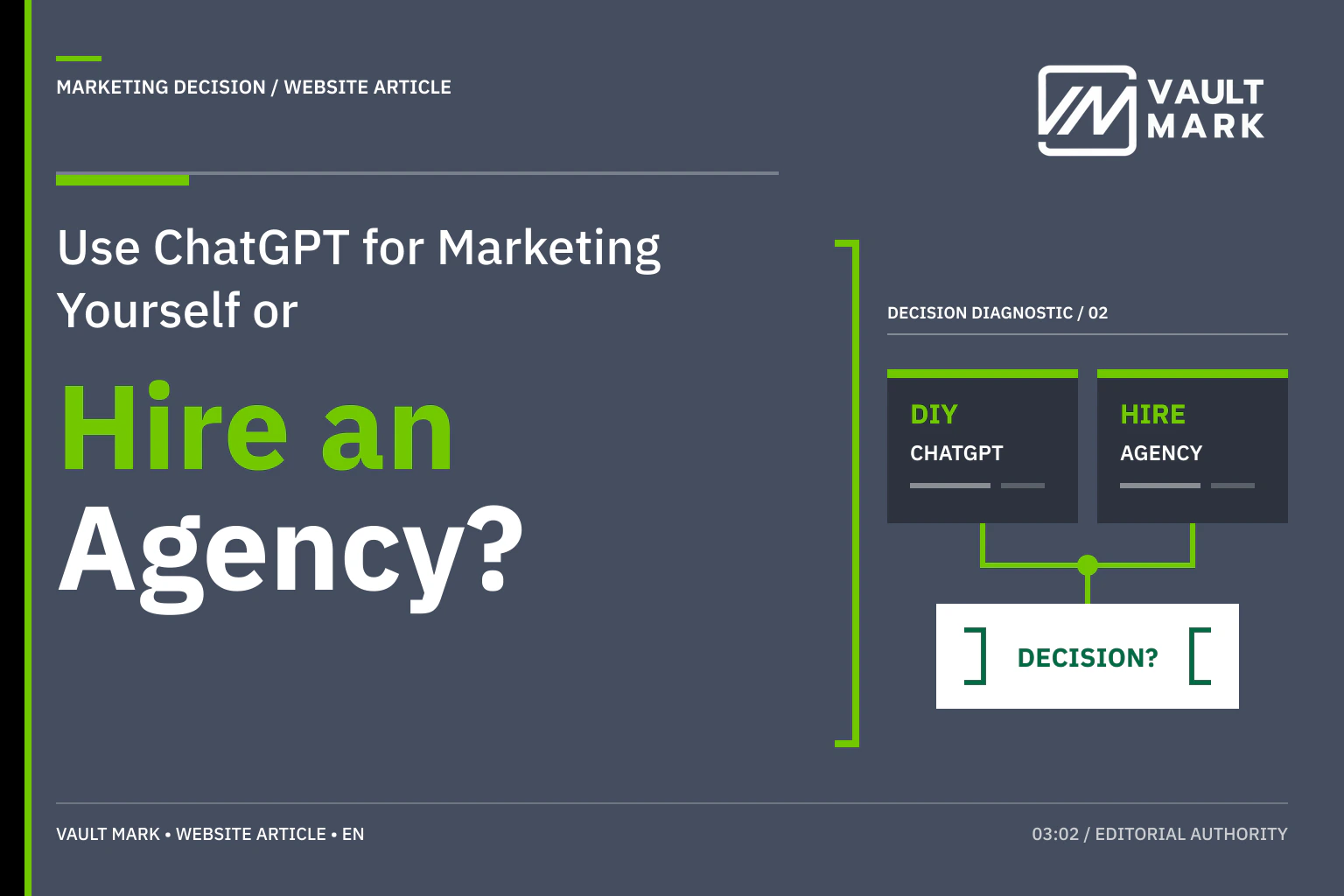
The sharper version of ChatGPT vs marketing agency is therefore not “which one is better?” It is: Does this task need only a tool to accelerate thinking, or does it need a decision system, proprietary context, implementation, and accountability?
What can ChatGPT genuinely help with in marketing today?
OpenAI’s current product documentation lists core capabilities such as answering questions, explaining concepts, drafting, rewriting, summarising, creative suggestions, reasoning, and translation. Depending on subscription and settings, ChatGPT can also use tools such as web search, file uploads, and data analysis. See OpenAI’s ChatGPT Capabilities Overview.
OpenAI Academy’s marketing guidance describes use cases across campaign planning, landing pages, email, ads, product messaging, research, content variations for testing, and performance summaries. See ChatGPT for marketing teams. When you have structured files, ChatGPT can also inspect uploaded data and produce tables or charts, subject to the capabilities and settings available to the account. See Data analysis with ChatGPT.
That makes ChatGPT a capable marketing co-pilot, especially for work with a clear question and a verifiable output. Tool capability, however, is not the same as business accountability. Someone still has to define the objective, provide the right context, decide which evidence is trusted, approve the output, implement changes, and judge whether the result was good enough.
When a whole team is already using AI, the operating issue often becomes inconsistent prompting, review, and handoffs. Vault Mark’s AI Prompting & Workflow OS for Marketing Teams addresses that team-workflow problem. This article owns a different decision: which tasks you can sensibly do yourself, which require review, and which require a stronger operating system or specialist support.
Why is “use ChatGPT or hire an agency?” usually the wrong question?
ChatGPT is a tool that can help generate, analyse, structure, and transform information. An agency, in-house team, or consultant is a model for ownership and execution. They are not mutually exclusive. You can use ChatGPT with an internal team, with an agency, or on your own without hiring anyone.
Before asking whether to hire, answer five questions:
If these are easy to answer, you may not need an agency. If ownership and evidence are scattered across several functions, the constraint is often the operating model rather than the prompt. That is where AI operations and workflow design or a clearer data and measurement spine becomes more important than adding another AI tool.
AI Marketing Capability Boundary Map: where is DIY enough, and where should control increase?
| Marketing task | DIY with ChatGPT | Minimum human QA | Trigger for system/specialist support | Evidence before release |
|---|---|---|---|---|
| Ideation / brainstorming Angles, topics, questions | High fit | Check customer relevance and positioning | When ideas become budget or brand-direction decisions | Brand context, ICP, objective |
| Drafting / repurposing Email, posts, landing-page structure | High fit | Fact, tone, offer, CTA, claims | Regulated claims, pricing, contracts, or material public statements | Approved sources, brand rules, offer truth |
| Research / competitive scan | Medium–high fit | Verify source, date, scope, and inference | Market-entry, major budget, or competitor claims | Primary sources, dated evidence, limitations |
| Data analysis CSV, performance table, survey | Medium–high fit | Metric definitions, data quality, calculations | Conflicting systems or outputs that drive budget/revenue decisions | Metric dictionary, source of truth, reproducible calculations |
| Channel / budget priority | Medium fit | Business owner confirms constraints and trade-offs | Several channels, goals, or historical datasets must be interpreted together | Baseline, economics, capacity, decision rules |
| Campaign execution Ads, website, CRM, automation | Low–medium fit | Configuration QA, access, tracking, rollback | Changes touch live accounts, money, customer data, or multiple systems | Access map, change log, test plan, owner |
| Measurement / attribution | Medium fit | Separate observed, modelled, and sales-confirmed data | Revenue closes offline/through sales or CRM stages are unreliable | Event map, CRM status, revenue fields, caveats |
| High-risk / regulated communication | Low fit | Qualified, authorised reviewer | Legal, privacy, medical, financial, or material reputation risk | Qualified review, approved sources, audit trail |
The governing principle is simple: the higher the consequence of being wrong, the less sensible it is to treat “the AI can produce an answer” as sufficient evidence that AI should own the decision. The tool may still assist in every row; the level of evidence, review, and accountable ownership should rise with risk.
What should the Human QA Gate include before an AI-assisted output goes live?
Human QA is not “someone skimmed it.” A useful gate defines conditions that stop the work from shipping. At minimum, review five areas:
- Truth Gate: facts, numbers, product names, prices, terms, and sources match the current source of truth.
- Context Gate: the output reflects the real customer, business objective, constraints, channel, and operating context.
- Brand & Risk Gate: positioning, claims, sensitive information, and tone are within approved boundaries.
- Execution Gate: the implementer knows what to change, who approves it, and how to roll it back if needed.
- Measurement Gate: there is a baseline and a credible way to tell what changed after implementation.
If you are running many AI-assisted ideas at once, do not turn ChatGPT into a backlog of untested suggestions. Tie experiments to success criteria and a review cadence. Vault Mark’s AI-GrowthLab OS illustrates that operating principle.
Three practical scenarios: when is DIY rational, and when should support increase?
Scenario 1: a small-business owner wants faster posts, emails, and landing-page drafts
If the offer is clear, the audience is known, claims are low-risk, and a responsible person checks the output before publication, this is a strong AI marketing DIY use case. ChatGPT can help explore angles, draft, shorten or expand copy, create a first TH/EN pass, and identify questions a page should answer.
The business still owns offer truth, pricing, differentiation, evidence, and approval. Hiring an agency merely to gain access to AI would add little value.
Scenario 2: a high-ticket B2B company runs Ads + SEO + sales + CRM, but lead quality is falling
ChatGPT can summarise search terms, sales feedback, win/loss notes, and campaign reports. But “where should we move budget?” should not be decided from one report. The answer depends on lead source, sales stage, revenue, cycle time, and what the sales team can actually confirm.
Here, the problem is not lack of AI proficiency. It is a fragmented evidence and decision system. Marketing, sales, measurement, and commercial owners need a shared view—whether those people are internal, external, or mixed. The goal is to make measurement decision-ready, not merely ask AI to narrate a dashboard.
Scenario 3: a business operates where inaccurate claims carry material risk
AI can still help structure a draft or produce a plain-language version. Final approval, however, should sit with appropriately qualified and authorised reviewers for the actual risk involved—such as legal, privacy, medical, financial, or compliance stakeholders. Human review reduces risk; it does not erase residual risk.
When is it reasonable to use ChatGPT for marketing yourself?
If you want to use ChatGPT for marketing yourself, DIY is usually defensible when most of these conditions are true:
- The task is self-contained and does not require several systems to coordinate.
- You have a source of truth you can verify against.
- The downside of a wrong output is easy to reverse.
- You know the objective and how quality will be judged.
- A named person owns final approval.
- Sensitive or personal data is not being uploaded without a clear policy.
- The outcome does not depend on complex Ads, tracking, CRM, or website implementation.
For sensitive business information, check the product plan and data policy before uploading. OpenAI states that data from ChatGPT Business, Enterprise, and other listed business products is not used to train models by default. Individual/consumer controls and product settings should not be assumed to be identical. See OpenAI’s business data privacy information.
When should you add an internal team, specialist, or marketing agency?
External support is not valuable because an agency has a “better ChatGPT.” It is valuable when you are buying capabilities the tool alone does not supply end-to-end: ownership, sequencing, implementation, QA, specialist judgement, and accountability.
Signals that support should increase include:
- The problem is unclear: every stakeholder recommends a different channel, with no shared evidence of the true constraint.
- Several systems must connect: Ads, website, analytics, CRM, sales, and content need coordinated changes.
- The consequence is high: the decision affects significant budget, revenue targets, or reputation.
- The data disagrees: platform dashboards, analytics, CRM, and sales tell different stories.
- Execution lacks an owner: the strategy exists, but no one owns configuration, production, QA, and ongoing review.
- Specialist review is required: privacy, legal, compliance, or technical dependencies exceed generalist judgement.
If the priority is already clear, a specialist or focused external execution team may be the shortest path. If it is still unclear what should come first, buying execution immediately can simply increase activity around the wrong problem. That is the point of Vault Mark’s Customer Growth Blueprint: diagnose the constraint and sequence before adding more budget, tools, or people.
Vault Mark does not assume that clients should outsource everything. Its current operating position explicitly allows working alongside internal teams and existing partners when the need is sharper sequencing and priorities. That matters because good AI adoption should increase internal capability, not create unnecessary dependency.
What mistakes make ChatGPT marketing look cheaper but cost more later?
- Treating a first draft as final: fluent copy is not evidence that facts, offers, or claims are correct.
- Asking for strategy without a baseline: without economics, audience, constraints, and performance history, the answer can only be generic.
- Summarising data before metric definitions agree: AI can create a coherent explanation from an incoherent data foundation.
- Automating before naming an owner: automation can distribute errors faster as easily as it can distribute good work faster.
- Assuming an agency removes the need for an internal owner: the business still owns customer truth, account access, priorities, and final decisions.
- Buying an AI stack larger than the problem: if the need is simply draft + review, a large operating stack may create more overhead than value.
For organisations scaling AI across several functions, separate tools from operating design. Vault Mark’s AI Marketing OS overview shows the broader relationship between Strategy, Demand, Lead, CX, Data, and Ops so use cases do not become disconnected tool projects.
Frequently asked questions about ChatGPT vs marketing agency
Can ChatGPT replace a marketing agency?
Not as a universal rule. ChatGPT can replace or accelerate portions of research, drafting, summarisation, ideation, and analysis. An agency or internal team remains relevant when work requires privileged context, live implementation, QA, cross-channel coordination, specialist judgement, or accountability. Some marketing tasks do not need an agency at all.
Can ChatGPT build a marketing strategy?
It can help structure the problem, compare options, generate hypotheses, and synthesise evidence. A strategy that governs real investment should still reflect the company’s baseline, economics, customer evidence, capacity, and trade-offs, with a named human owner responsible for the final decision.
Should a small business start with ChatGPT before hiring an agency?
For a clear, low-risk problem, that can be a sensible approach. Using ChatGPT on bounded tasks helps you learn where AI genuinely saves time, where human judgement remains essential, and where the real capability gap lies before you buy external support.
Can we put all company information into ChatGPT?
No. “The tool accepts the file” is not a data-governance rule. Classify information first, check plan/workspace policy, access permissions, retention, and organisational requirements—especially for customer data, personal data, contracts, or confidential material.
If we already have an agency, should our internal team still use ChatGPT?
Yes, where policy permits. Internal AI literacy can improve briefing, review, and decision quality. An agency is not a reason to remove the internal owner; an AI-capable internal team is not automatically a reason to eliminate external specialists either.
Sources, evidence use, and limitations
- OpenAI — ChatGPT Capabilities Overview: supports statements about core capabilities and plan/settings-dependent tools.
- OpenAI Academy — ChatGPT for marketing teams: supports current marketing use cases across campaigns, content, research, and performance analysis.
- OpenAI — Data analysis with ChatGPT: supports statements about uploaded data, tables, and charts.
- OpenAI — Business data privacy: supports the default model-training statement for the listed business products.
Use ChatGPT for marketing yourself by matching control to the task—not by chasing the AI trend
If the task is bounded, reversible, and easy to verify, use ChatGPT yourself first. You do not need a system larger than the problem. If the decision connects budget, data, several channels, sales, measurement, or high-risk claims, increase evidence, ownership, and governance in proportion to the consequence.
If the real issue is “we still do not know what should come first”
Do not begin by choosing a tool or an agency. Clarify the constraint and priority first. See whether Customer Growth Blueprint is the right first step, then decide whether the answer should be DIY, handled by the existing team, supported by a specialist, or moved into a focused execution path.