
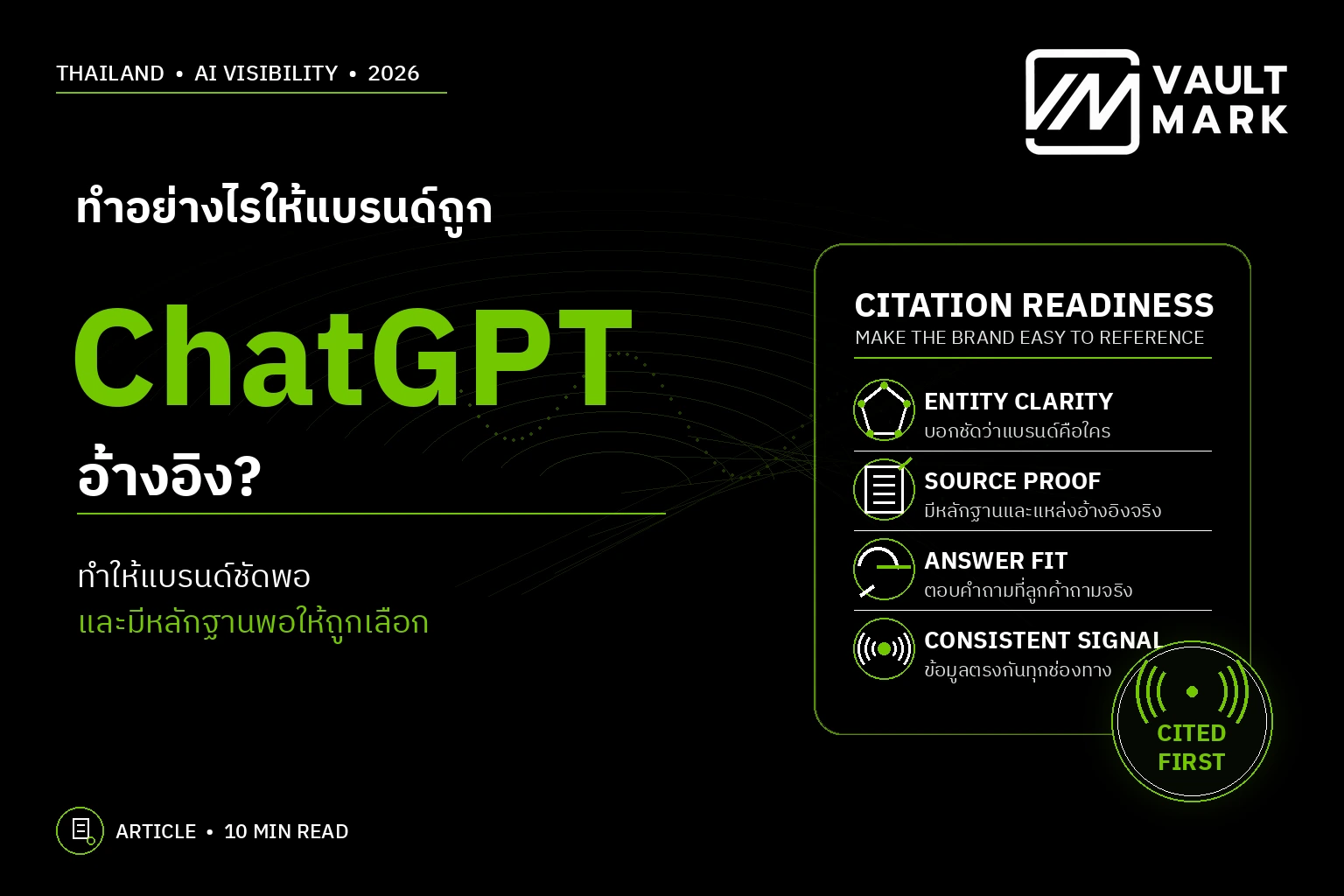
Getting ChatGPT to cite your brand means making your content discoverable, immediately usable, and credible enough to be selected over competing sources. It is not about “tricking the algorithm”. It is about providing the strongest answer in a format machines can find, understand, and use.
ChatGPT is more likely to cite a brand when three layers are working together: (1) OpenAI’s search crawler can access the site, (2) the content answers the question in a clear, self-contained passage, and (3) the brand is supported by credible signals beyond its own website, such as reviews, directory profiles, and independent mentions. If one layer is weak, the page may remain eligible yet still be overlooked.
How Does ChatGPT Select Sources to Cite?
When a question benefits from current information, ChatGPT Search can retrieve information from the web, rewrite the user’s request into more targeted searches, review relevant pages, and produce an answer with source links. This is different from a conventional search results page because there is no visible list of ten positions to climb. From the brand’s perspective, the page is either selected for the answer or it is not. Selection is not reducible to Domain Rating alone: relevance, reliability, accessibility, and how completely the page resolves the specific question all matter. This is why a mid-sized Thai business can still compete with a much larger website when its page provides the clearer and more useful answer.
6 Conditions to Meet Before Your Brand Can Be Cited
1. Open the Door to the Right AI Crawlers
Check your robots.txt, hosting controls, CDN, and WAF configuration. For inclusion in ChatGPT Search summaries and snippets, the important OpenAI user agent is OAI-SearchBot. GPTBot is a separate control related to potential model training, so it should not be treated as the requirement for search citations. For other platforms, review the relevant search and user-request agents, such as PerplexityBot, Perplexity-User, Claude-SearchBot, Claude-User, and Bingbot. Many websites unintentionally block legitimate crawlers through security plugins or bot-mitigation rules, withdrawing from the field before the competition begins.
2. Make Sure Bing Can Discover and Index Your Site
ChatGPT Search may use third-party search providers, including Bing, and Bing also supports Microsoft Copilot and other AI-powered search experiences. Thai businesses often monitor only Google Search Console and never configure Bing Webmaster Tools. That leaves a blind spot in crawl status, indexing, search performance, and AI citation visibility across the Microsoft search ecosystem. Bing is not the only route into ChatGPT, but it is an important discovery and measurement layer that should not be ignored.
3. Write Answer-First Content
Each important page should include a concise, self-contained answer near the top that resolves the primary question without forcing the system to reconstruct the meaning from several paragraphs. A 40–60-word block can be a useful editorial target when the question can genuinely be answered at that length, but it is not a universal technical requirement. Clarity and completeness matter more than hitting an exact word count.
4. Use a Structure Machines Can Read
Use headings based on real questions, along with tables, comparisons, lists, and appropriate schema markup such as Article and FAQPage. These elements can help search and answer systems understand what the page covers, who it serves, and how its information is organised. Structured data improves clarity, but it does not guarantee rankings or AI citations on its own.
5. Build Credibility Beyond Your Own Website
Independent evidence can help systems corroborate that a brand is a real and established entity. Relevant reviews, reputable directories such as Clutch or Sortlist, media mentions, and consistent business information across platforms all strengthen that evidence. A brand discussed only on its own website has less independent corroboration than a brand that appears consistently across trustworthy third-party sources.
6. Publish Original Information Competitors Cannot Replicate
Original surveys, real case data, first-party benchmarks, and Thailand-specific market findings can give a page a stronger reason to be cited because they contribute information that generic articles cannot reproduce. One well-designed proprietary dataset can therefore create more citation value than a large volume of interchangeable content.
A 15-Minute Checklist Before Hiring Anyone
- Open
yourdomain.com/robots.txt— isOAI-SearchBotblocked? - Ask ChatGPT questions your real customers use — does your brand appear, and which brands appear instead?
- Search for your brand in Bing and check Bing Webmaster Tools — can Bing discover and index the relevant pages?
- Open your main service page — is there a complete passage an AI system could quote or summarise without rewriting the core meaning?
If you answer “no” to two or more checks, the problem likely includes an access, discovery, or page-structure issue—not only a content-writing issue.
From the Term You Searched to the Business Problem You Actually Need to Solve
Most people searching for “SEO services” or “a marketing agency” are experiencing one of the same two symptoms: they ask ChatGPT about products or services in their own category and see only competitors, or their Google rankings remain stable while enquiries keep declining. These symptoms are not solved by simply increasing the volume of conventional SEO work. They require a diagnosis of where the brand is dropping out of the AI answer cycle across the six conditions above.
The Boundary That Needs to Be Stated Clearly
The checklist above can reveal whether a problem exists, but it cannot determine which layer is causing the loss, what should be fixed first, or what level of investment is justified. Those decisions require a direct comparison between your business, your competitors, and the real citation data available across relevant search and AI systems. If the symptoms above match your business, request an assessment of whether the Customer Growth Blueprint is suitable before committing a large budget to the next round of marketing activity.
Frequently Asked Questions
Does ChatGPT cite Thai-language websites?
Yes. ChatGPT Search can cite Thai-language pages when they are accessible, relevant, and useful for the user’s question. Thai businesses therefore do not need to publish only in English to become eligible for citations, although the strength of the competing source set varies by topic.
Do You Need a High Domain Rating First?
No published OpenAI requirement says a website must reach a particular Domain Rating before it can be cited. ChatGPT Search uses multiple factors intended to surface reliable and relevant information. Domain authority may support discoverability, but page-level relevance, accessibility, clarity, and source quality remain important.
How Long Does It Take to See Results?
There is no reliable fixed timeframe for receiving a ChatGPT citation. Discovery and indexing can take days or weeks depending on crawl frequency, technical access, content quality, query demand, and competition. XML sitemaps and IndexNow can improve discovery and freshness in supported search engines such as Bing, but neither submission method guarantees indexing or a citation.
Should You Block AI Crawlers to Prevent Content Copying?
The controls should be separated by purpose. Blocking OAI-SearchBot can reduce your content’s eligibility for inclusion in ChatGPT Search summaries and snippets. Blocking GPTBot is a separate choice concerning potential model training. Businesses should evaluate visibility and content-control objectives independently rather than treating every AI crawler as the same system.
How Is This Different from AEO?
This work is one part of AEO (Answer Engine Optimization). AEO is the broader system for improving visibility across answer platforms, while this article focuses specifically on the technical and content conditions that influence whether ChatGPT can discover and cite a brand.