Entity & Schema Foundation: Building clear brand, product and service entities for AI Search
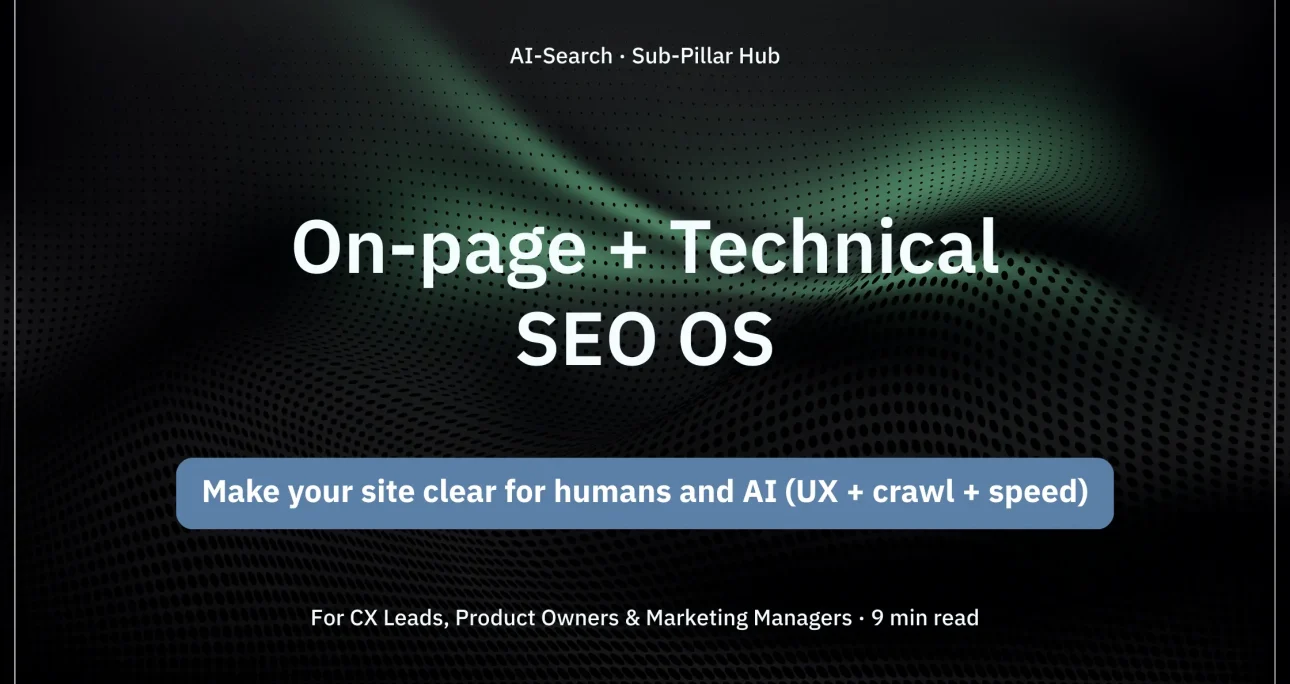
The AI On-page, Technical & Experience SEO OS is Vault Mark’s system for making websites truly understandable to both humans and AI. At its core is an Entity & Schema Foundation: consistent brand/product/service naming, Organization / Product / Service / LocalBusiness schema, and strong NAP consistency. Together, they help AI Search clearly recognise who you are, what you offer and how you relate to your category in Thailand and beyond.
Why 2026 on-page / technical / experience SEO must be AI-first
In many Thai organisations, “on-page SEO” still means:
- Put keywords into title and H1
- Adjust meta descriptions
- Maybe tweak a few headings
But in an AI-first world with:
- AI Overviews
- Answer engines (AEO)
- GEO / AI citation
- Local / Map / “near me” results
your site also has to tell search and AI systems, very clearly:
- Who your brand is
- Which products and services you offer
- Where you operate
- How all of this fits into known categories and entities
Without that, you risk:
- Being invisible or misclassified in AI answers
- Losing local/map visibility despite “okay” content
- Letting competitors with stronger Entity SEO own your category
The AI On-page, Technical & Experience SEO OS is built to fix that at the entity level, not just at the keyword level.
What is Entity & Schema Foundation in Vault Mark’s OS?
1) Define the “main characters” in your brand universe
Before schema markup or Core Web Vitals, we need a clean list of entities:
- Brand entity – official brand name(s) in TH/EN, legal company name, logo, primary domains
- Product / service entities – names, categories, typical packages or tiers
- Location entities – HQ, branches, cities, countries served
- Use case / industry entities – who you really serve and what problems you solve
If these “characters” are fuzzy or inconsistent across website, social, Line OA and directories, AI will struggle to understand and connect your presence.
2) Map entities to schema: Organization / LocalBusiness / Product / Service
Once entities are clear, we translate them into structured data that search and AI can consume:
- Organization schema – for your company/agency, especially B2B
- LocalBusiness schema – for physical branches, clinics, restaurants, showrooms, etc.
- Product schema – for individual products, SKUs or ecommerce items
- Service schema – for B2B/B2C services that aren’t “products”
Inside those, we describe things like:
- Name, URL, logo, description
- Business type, service type, categories
- Price ranges, reviews, ratings, images (where appropriate)
- SameAs links to key profiles (social, directory, authoritative listings)
The goal is for AI Search to see a coherent entity graph, not a scattered set of pages.
3) NAP consistency: the “small detail” with big impact
NAP consistency (Name / Address / Phone) is one of the most underrated foundations:
- Slightly different brand names (Co., Co., Ltd., จำกัด, ฯลฯ) across platforms
- Different phone numbers or addresses on website vs Google Business Profile vs directory sites
- Old opening hours never updated
For humans, that’s mildly confusing. For AI, map and local systems, it can break the chain of trust. The OS therefore emphasises:
- One master NAP record owned by a specific team
- Clear rules for how the brand name appears in TH/EN
- Regular checks to keep website, GBP, directories and social in sync
This is critical if you want Local / GEO authority, not just generic SEO.
The AI On-page, Technical & Experience SEO OS: three interlocking layers
Vault Mark treats this OS as three connected layers:
- Page & Template Experience – how individual pages and templates are structured
- Entity & Schema Foundation – how your brand and offerings appear to AI Search
- Consistency & Governance – how you keep all this clean over time
Layer 1: Page & Template Experience
Think page-level and template-level together:
- Page-level
- Is the title/meta/heading aligned with the real intent of the page?
- Do we have an Answer Block and, where relevant, FAQs to support AEO?
- Is the copy readable for humans, not just keyword repetition?
- Template-level
- Do product/service/blog/FAQ templates actually provide slots for key information?
- Does the layout help both users and AI see structure (H1–H2–H3, bullets, key facts)?
This is where on-page SEO touches UX – not just “what words we use”, but how we package information.
Layer 2: Entity & Schema Foundation
Here we connect pages to the entities behind them:
- About / Brand pages link into Organization schema
- Location / contact pages link into LocalBusiness schema + NAP consistency
- Product / service pages link into Product / Service schema and category trees
This helps AI Search answer questions like:
- Which brand is this?
- What services does it actually provide?
- Are these services relevant to this query in Thailand or APAC?
For GEO and Local, this layer is what tells AI “this brand is a legit, well-defined player in this category and geography”.
Layer 3: Consistency & Governance
In a fast-changing digital environment, data drift is real. The OS therefore insists on:
- Clear ownership of Master Brand Info (names, NAP, key URLs, social profiles)
- A simple governance rule: any major change (rebrand, move, new branch) triggers a specific checklist of updates
- AI used as a scanner to spot mismatches in brand names, addresses and service descriptions across major platforms
On-page and tech SEO are no longer just “dev tasks”. They span marketing, CX, brand and sometimes legal/compliance as well.
How far can AI go as an SEO/UX co-pilot (without overstepping)?
Under Vault Mark’s Iron Rules, AI is used to think and review, not to silently rewrite everything in production.
Good use cases for AI
- Read a Thai page and give high-level feedback on:
- Whether title/heading reflect user intent
- Whether the H1–H2–H3 structure is clear
- Where FAQs or internal links could help
- Suggest Quick wins like:
- Adding internal links between related pages
- Adding succinct FAQs that reflect actual questions
- Tightening or simplifying confusing sections
Where humans must still decide
- Final wording for titles/description to balance brand voice, intent and CTR
- Trade-offs between SEO tweaks and design/UX/brand consistency
- Any major UX/layout changes that might affect conversion
AI should be your SEO/UX co-pilot, not an uncontrolled auto-pilot.
Connecting Entity & Schema Foundation to GEO and Local
Once Entity & Schema Foundations are in place, several doors open:
- Higher chances to be perceived as a reference source (GEO) when AI answers category-level questions
- Stronger eligibility for Local / Map / “near me” visibility due to consistent NAP and LocalBusiness schema
- Better understanding, by AI, of the relationships between:
- Brand → product & service families → use cases → industries → locations
This is what Vault Mark calls Experience SEO: not only “fast pages”, but clear brand understanding for both humans and AI systems.
FAQ – AI On-page, Technical & Experience SEO OS
1. How should we think about on-page SEO at page-level vs template-level?
Modern on-page SEO requires both. Page-level: make sure each URL has titles, headings, Answer Blocks and content that match a specific user intent. Template-level: design product/service/blog/FAQ templates so every new page in that category automatically exposes key fields (benefits, specs, FAQs, schema) in a consistent way. That’s how you scale quality rather than fixing one page at a time.
2. With limited resources, which technical SEO issues should we fix first (speed, mobile, indexability)?
For SMEs with limited resources, a pragmatic order is:
Indexability – ensure key pages can be crawled and indexed.
Mobile experience – most Thai users are on mobile first.
Basic Core Web Vitals – pages should not be painfully slow or jumpy.
Once these are acceptable, you can refine further in later cycles, rather than chasing every minor metric from day one
3. Can AI review Thai pages and give rough SEO/UX feedback?
Yes, AI can provide rough, directional feedback: whether the page structure is clear, whether headings match content, where FAQs might help, which sections feel redundant. This is valuable as input, especially for non-technical teams. But final decisions should still be made by humans who understand brand, strategy and business priorities.
4. Is it still necessary to write keyword-stuffed titles/descriptions, or should we prioritise intent and CTR?
Keyword stuffing is outdated. Today, titles and descriptions should:
Signal intent clearly: what problem this page solves
Encourage clicks (CTR) in a way that respects brand voice
Include key entities/terms naturally, including Thai/English mixes for technical terms like SEO, Schema, AI
Think of them as signboards that must quickly explain “who you are and what you solve”, not just dump keywords.
AI Prompt (public) – for Vault Mark AI Marketing OS GPT
Use this to get high-level on-page/UX/tech feedback on a Thai page. It is not a full SEO plan or coding SOP.
You are an AI SEO UX & tech reviewer.
I will give you a Thai URL or page copy.
Tasks:
1) วิเคราะห์ On-page (Title, Heading, Content) แบบสั้น ๆ
– ชี้ให้เห็นว่า Intent ชัดไหม, โครง H1–H2–H3 อ่านรู้เรื่องไหม
2) ชี้ 3 Quick wins ที่จะช่วย SEO & Experience ดีขึ้น
– เน้นข้อเสนอระดับแนวคิด (เช่น เสริม FAQ, ปรับ Internal Link, ปรับ Heading)
– ไม่ต้องลงรายละเอียดเชิงโค้ดหรือ SOP ละเอียด
ตอบเป็นภาษาไทย พร้อม English headings (On-page / UX / Quick wins)
Next Step
If you want your site to be crystal-clear to both humans and AI – not just “technically okay”:
- Download the On-page & Tech SEO OS Checklist (EN) to benchmark your current on-page, technical, experience and Entity & Schema foundations.
- Book an AI SEO UX & Tech Audit Session with Vault Mark to:
- Scan key pages and templates
- Design a tailored Entity SEO, Brand/Product/Service Schema and NAP Consistency plan
- Build an AI On-page, Technical & Experience SEO OS that fits your real resources and business goals.
From there, the Vault Mark AI Marketing OS article series plus Vault Mark AI Marketing OS GPT can act as your ongoing playbook and co-pilot, helping you maintain a strong, AI-ready brand presence across search, answers and local surfaces. 🚀